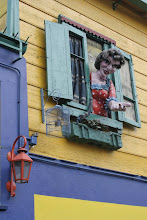
Barrabravas intrigue me. Are they hooligans, plain mafia, or what? Originally they certainly were the local barrios soccer team's passionate hinchas or supporters. Now they also unite in the code of violence, expressed machismo, intolerance toward others and obscure connections to the clubs management.
The anthropological gaze of Jose Garriga Zucal at porteño soccer makes it possible to understand more of the circle of passion and personal bonds which are tied between supporters, the social fundament of the violence, machismo and intolerance, and the twirl these values has taken the last few decades in the way of manifesting loyalty to a football team.
Submitting himself as participant observer into the barrabravas of Huracán, he aimed to explore the patrons of the barrabravas, and above all, to find out where the violence of Argentinian soccer is located.
The soccer scene are too complex to deem barrabravas all guilt of violence. They are certainly the most violent, but they are not the only ones. And they are as heterogeneous as the rest of us. Some are robbers, other professionals, some are drug addicts, others do not consume drugs at all. But there is one trait he found which unite; The stamina, the persistence. The heterogenous barrabravas unite here, they are fighters. To become a member, you must fight. You must show yourself. They fight each others, not the other spectators, the players or the management. They do not report to the police. When the Boca hinchas fight the Chacarita hinchas, they keep the trouble internal. Nobodys else's business. That is the code. The code also says not to use weapons, but sometimes they do. Codes exist to be broken. It is like driving on red.
To participate or distance oneself from the barrabravas is a question of class, even though the fascination for violence is the same whithin very different social groups. Barrabravas from River are upper middle class. The political and social idea that violence equals poverty, does not stand.
River and Boca have the largest barrabravas of Buenos Aires, numbering four to five hundred members. Huracán and San Lorenzo numbers between two and three hundred.
The leader of a barrabrava needs more qualificastions than to be a good fighter, he has to know the mechanisms of distribution, and he needs a certain amount of charisma.
It will be interesting to follow the court case of the brothers Alan and William Schlenker. The snob Alan, River barrabravas' leader, is accused of murdering a rivaling River barrabrava.
Wednesday, December 26, 2007

Now: Economics
December 1st 2001, Noticias published the economist Gabriel Rubinstein's forecast El futuro argentino (The Argentinian Future). Two possible and distinct countries were sketched, with 40 % chance of convertability and growth in the first and 60% likelihood for collapse in the second. Pending set of economical variables were financial pace, deposital freeze, likelihood for default and devaluation, drainage of deposits and bank credits, brutal fall in GNP, dramatic fall of Merval and uncontrollable leaps of the Riesgo Pais.
The forecasts painfully fulfilled themselves. Nothing the like had happened before, and as Rubinstein today says, even the worst scenario for the future cannot come close to the apocalypse of 2001. The dynamics of the scenarios for 2008 are similarly positive and negative, with a 50% probability of normal growth and 50% chance of unstable economy.
The outcome is not only given by governmental desitions to adjust macroeconomic imperfections. It depends as much on producer and consumer sectors, that is, microeconomics. Despite the massive recovery Argentinian economics has had the last years, Rubinstein warns Argentina against relaxing too early:
The high debts at sky high interests North American consumer has acquired, followed by crisis in mortgaging and the housing market, might well affect Argentina through a weakened dollar. The govermental handling of Argentinas US$ 6,2 billion debt to the Paris Club will determine The World Bank's approval of a payment plan when Argentina proves stable. Workers unions with leader Hugo Moyano up front are demanding wage increases scaling up to 25%, driving inflation. And lastly, all of us influence inflation: Can I wait until tomorrow to buy what I want to acquire today? New mobile, better car, plasma television?
A stable economy for 2008 depends on the following variables:
Argentina needs a stable dollar at 3,15-3,20 pesos/dollar, and Banco Central must continue to by dollar to fill national reserves.
Bank deposits must continue to rise and consumer index should be fixed at 7% throughout 2008.
Gas, light, water etc. should not rise above 15% on behalf of the middle class, less for the poor.
Summa summarum; Controlled inflation depending on the consumer's will to brake consumtion, stable dollar, dollar savings by Banco Central, increased investments, price control on behalf of nessecary consumer goods according to Pacto Social should open a stable scenario for next year and futher future.
Let us see what the new secretary of treasure, wonderboy and microeconomist Martín Lousteau will propose. Well aware of the producer/consumer challenge, he claims that Paris Club can wait.
The forecasts painfully fulfilled themselves. Nothing the like had happened before, and as Rubinstein today says, even the worst scenario for the future cannot come close to the apocalypse of 2001. The dynamics of the scenarios for 2008 are similarly positive and negative, with a 50% probability of normal growth and 50% chance of unstable economy.
The outcome is not only given by governmental desitions to adjust macroeconomic imperfections. It depends as much on producer and consumer sectors, that is, microeconomics. Despite the massive recovery Argentinian economics has had the last years, Rubinstein warns Argentina against relaxing too early:
The high debts at sky high interests North American consumer has acquired, followed by crisis in mortgaging and the housing market, might well affect Argentina through a weakened dollar. The govermental handling of Argentinas US$ 6,2 billion debt to the Paris Club will determine The World Bank's approval of a payment plan when Argentina proves stable. Workers unions with leader Hugo Moyano up front are demanding wage increases scaling up to 25%, driving inflation. And lastly, all of us influence inflation: Can I wait until tomorrow to buy what I want to acquire today? New mobile, better car, plasma television?
A stable economy for 2008 depends on the following variables:
Argentina needs a stable dollar at 3,15-3,20 pesos/dollar, and Banco Central must continue to by dollar to fill national reserves.
Bank deposits must continue to rise and consumer index should be fixed at 7% throughout 2008.
Gas, light, water etc. should not rise above 15% on behalf of the middle class, less for the poor.
Summa summarum; Controlled inflation depending on the consumer's will to brake consumtion, stable dollar, dollar savings by Banco Central, increased investments, price control on behalf of nessecary consumer goods according to Pacto Social should open a stable scenario for next year and futher future.
Let us see what the new secretary of treasure, wonderboy and microeconomist Martín Lousteau will propose. Well aware of the producer/consumer challenge, he claims that Paris Club can wait.
Tuesday, December 25, 2007
Christmas at Hilton
.jpg) Midsummer passed leaving the city "India before-monsoon-hot", sweating with 36ºC.
Midsummer passed leaving the city "India before-monsoon-hot", sweating with 36ºC.We sneak into the Hilton, luxuriating by the pool with sky-high umbrella drinks and arrogant faces.
That was also the day to commemorate the economic collapse of 2001. December wages never came, the banks ran out of money. Every time the banks run out of money, I feel a chill running down my back.
Christmas eve best spent in a tranquil spa, massaged, chocolate-smeared and trimmed from head to toe.
Later dining on underestimated Mendozan, tannin-toxic red wines and beef best eaten with a spoon. Followed by chocolate-and-liqueur-creamcake threatening to sag in its own juices.
Nightsky exploding with fireworks from midnight until five. Can you catch the priest's soothing speech adressing lonely souls at midnight mass?
"I'm not there", Narcotango and Incubus floating from the stereo.
Boliches go crazy with youngsters tired of old folks.
The city which never sleeps, now sleep in the christmas intoxication. I can hear the birds sing.
A slow bus snails down the road. Christmas-break at the soccer-fields, my old man can rest...
Wednesday, December 19, 2007
Copyutopia
 Art is not characterized by hegemony in respect to other fields. Beauty and truth are no longer exclusive to art. Rather than these qualities, certain conditions and mechanisms define a work of art at a given moment. But even if this is the state of things, enough remains. Art still remains a field where determined circumstances, qualities and desires become visible. And there remains the option to advert a vocabulary, a series of motives, gestures, concepts and reflections particular to this field.
This immanent change within the art field collaborates in order that its boundaries remain porous. More artistic elements are discussed outside the field of visual arts. It is as if arts autonomy were in bits and pieces, and they were all distributed. Elements which together conform art, we now find scattereded in every field imaginable. Diedrich Diedrichsen calls this process "New visual rutines". The look is widened. Arts failed purpose, one of the elements which constituted freedom of art, the freedom, since Kant, which justifies arts own rules, we no longer find them in visual arts. In a certain way, the artistic language is returning to its original definition, which embraces far more fields than visual arts.
Extract from "Cruzar las fronteras en lugar de importar y exportar" in La Utopia de la Copia by Mercedes Bunz.
Mercedes Bunz believes in the Internet, she lives in Berlin and is editor of Tagesspiegel Online. Since 1997 she has edited DE:BUG, one of Europes most important magazines for electronic music and world view. Co-founder and connected to Bauhaus Universität Weimar, she wrote her PhD thesis on the history of Internet, now published on Kadmos Verlag. Cultural critique and journalist, a student of Dietrich Diedrichsen, author of Persons in Loop (Personas en Loop), she recently published The Utopia of Copy (La Utopia de la Copia), a compilation of articles published in German media.
She questions art, genre, style, age, sexual identity along with our contemporary society and world. Her essays are portraits of everyday life and a map of cultural consumption in discource with thinkers like Walter Benjamin and Jacques Derrida. The essays can also be read as a survey of the mode in which contemporary esthetics are produced: From the Internet to the fanclubs of Kraftwerk, Missy Elliot and the new liberal pop.
Blog
Tagesspiegel
Sand and Salt in Mar del Plata
.jpg)
.jpg)
.jpg)
.jpg)
.jpg)
.jpg)
.jpg)
Media(r)evolution?
How overestimated are the old media, how innovative are the new ones?
It seems obvious: The old media are dead, live the new! This calls for a discussion of differences and similarities of new and old media and try to identify both benign and malign features, effects and consequences while at the same time visualize the media world in the near future. Who are better skilled to discuss this topic, if not journalists or artists who know both worlds well?
It seems obvious: The old media are dead, live the new! This calls for a discussion of differences and similarities of new and old media and try to identify both benign and malign features, effects and consequences while at the same time visualize the media world in the near future. Who are better skilled to discuss this topic, if not journalists or artists who know both worlds well?
Thursday, December 6, 2007
.jpg)
The world according to Cristina
Nobody knows exactly what Cristina stands for. She will probably distance Argentina from Chavez and Venezuela, although at a point after the crisis, Venezuela was the only buyer of Argentinian state obligations, most likely pure subsidies.
And the neverending conflict with Uruguay has to come to an end.
She identifies herself with Hillary, yet she gave a harsh speek at the Mercosur summit yesterday regarding the US' role on the continent. Where did the US$ 800 000 Venezuelan Antonini Wilson carried to Argentina in August, come from. The story came public just before the election, aiming to weaken Cristina's candidacy by speculating that they were black campaign money. "I will not allow any dirty pressure," she responded.
Similarly, in Bolivia, the strong opposition and demand for independence and autonomy in the three rich, southern provinces, is giving Evo Morales real headaches. They do not appreciate his nationalization plan for the energy sector. They want things to remain the way they are and the money to keep floating into their pockets instead of into the National Bank. And neither do the US. It is far easier to control a poor and scattered country than to control a unified population with cash in hand. Silvo da Lula and Michelle Bachelet even went to La Paz this week to demonstrate backup for Evo.
As far as Cristina goes, she is now coming forward with her view of things. She plainly said that the shit that happends on this continent comes from abroad. And abroad means the US. And so far they get away with it.
And the neverending conflict with Uruguay has to come to an end.
She identifies herself with Hillary, yet she gave a harsh speek at the Mercosur summit yesterday regarding the US' role on the continent. Where did the US$ 800 000 Venezuelan Antonini Wilson carried to Argentina in August, come from. The story came public just before the election, aiming to weaken Cristina's candidacy by speculating that they were black campaign money. "I will not allow any dirty pressure," she responded.
Similarly, in Bolivia, the strong opposition and demand for independence and autonomy in the three rich, southern provinces, is giving Evo Morales real headaches. They do not appreciate his nationalization plan for the energy sector. They want things to remain the way they are and the money to keep floating into their pockets instead of into the National Bank. And neither do the US. It is far easier to control a poor and scattered country than to control a unified population with cash in hand. Silvo da Lula and Michelle Bachelet even went to La Paz this week to demonstrate backup for Evo.
As far as Cristina goes, she is now coming forward with her view of things. She plainly said that the shit that happends on this continent comes from abroad. And abroad means the US. And so far they get away with it.
Sunday, December 2, 2007
.jpg)
The disappeared
 24th of November 1976 the military attacked the Mariani-Teruggi home, killed Diana Teruggi de Mariani and kidnapped her 3 month old daughter Clara Anahi Mariani.
Her husband was killed the following year, 1st of August 1977.
The family is still looking for Clara, now 30 years old. With whom did she grow up..?
The newspaper Pagina 12 prints these ads on the anniversaries of the dissappearances.
Héctor Febres, accused torturist from the early 80s, died strangely from Xyclon b, the Nazis´preferred assassination agent, in his cell 10th december. Sadly, along with his departure he brought with him his knowledge of the kidnapped and adopted children.
18th of desember Cristino Nicolaides, the last head of army during the dictatorship, former coronels and torturists Roldan Guerrieri and Arias Duval, in addition to ex policemen Julio "Turco Julián" Simón and Miguel Echegolatz were sentenced to 21-25 years in jail for their crimes during the dark years. El "Turco Julián" is said to know a lot about the missing and adopted children form those days. A couple a months ago, the police priest Cristian von Wernich, was similarly sentenced for giving away intimate information from the prisoners.
I wish the were all younger, so that they would spend more of their lives behind bars.
Subscribe to:
Comments (Atom)