The Argentinians adore their saints, canonized or not. Worshipped like angels or popular saints, Father of modern Argentinian tango, Carlos Gardell and everyone's Evita are the most obvious examples of great Argentinians who died young and tragically and after their death became imortal. Evita was honoured with 30 days of national mourning (!) after giving in to cancer. Gardell crashed in an airplane somwhere in Colombia in the thirties. Maradona will be next. Relating to saints is common in Catholisism and is far from madness, although different.
Roadside saints, mystrious shrines and sanctuaries was built in recognition of a popular pagan saint. Covered in ribbons and waving flags, packed with half-burnt candles, plastic bottles and make-do crosses, they are sites for bus and truck drivers who stop and say a little prayer, leave their offering and ask for blessings and a safe journey with a honking of horns.
Difunta Correa and Gauchito Gil are the big-names. During their lives, the suffering women and the brave gaucho both lived in the turbulent times of the mid 19th century, they both died tradically as unintended victims of the civil wars that hit Argentina at the time.
The faithful wife Difunta (deceased in Spanish) decided to follow her husband's steps to La Rioja when he, a federales political activist, was taken prisoner by an opposing militia, los unitarios. She never got to free him (or if that failed, bring his body home). Holding her young son in her arms, she died of thirst in the Caucete desert. Her story became legend stuff when a few days later, some shepards found her baby son alive and still breast-feeding from the deceased mother. Beleiving they had witnessed a miracle, they set up a cross on her burial ground on top of a small hill in the middle of a barren plain. Fifty years later, a herdsman crossing this hill on his way to Chile, was caught in a storm, loosing all his 500 cows. In desparation he prayed to the unknown grave to recover his cattle. It worked, he got them all back, and in gratitude he built a grotto with his own hands to the Difunta. It is just off the Ruta National 141, in the little town of Vallecito, 63 km east of San Juan. Hundreds of thousands arrive here during holy week, climbing up a set of stairs on their hands and knees.
Humbler, but growing, is the sanctuary of the Gaucho Gil in the north-east province of Corrientes. He found himself caught in the provincial civil wars between los celestes (light blue)and los colorados (red). Despite disinterest and lack of fighting skills he was recruited by the celeste Colonel Juan de la Cruz Zalazar, but tried to escape to the mountains and was decleared a deserter by the authorities. According to legend he became an Argentinian Robin Hood, stealing from the rich landowners of the region and distributing among the poor. He was also said to be able to heal the sick. Eventually he was found by the police, taken to court and hung hed-down from a tree. Just before he died, he said to his hangman: "When you get home tonight, you'll find that your son is about to die. You can ask me to save your child, because the blood of an innocent man helps perform miracles". Gil's executioner, regretting what he had don, erected a cross with a red ribbon hanging form the top. The site is located outside the city of Mercedes, 200 km south-east of Corrientes city. Every year, more than 100 000 people gather to commemorate his deth on 8 January. Devotees travel from all over the country to indulge in singing and dancing, mainly chamamé, the traditional folk rythm of Corrientes. Next to the shrine there is a campground, bars, cafés and stalls selling ultra-tacky souvenirs.
The pantheon of popular saints in Argentina does not end here, though. Also growing steadily in the devotional ranks are the various poor cousins of la Difunta and el Guchito: La Telesita, patron of the peasants form the norhtern province Santiago del Estero: the grisly cult of San la Muerte (Saint of Death) in the north-east, and more recently, the "canonized" figures of Gilda and Rodrigo, the popular Cumbia-singers who died young in car crashes during the 1990s. They have huge fan groups who meet at their graves, particularly at weekends, eat, drink, sing and decorate the graves with balloons and flowers, offerings of cigarettes and they bring crusifixes and pictures of Virgin Mary. The practice is stigmatized and a pronounced lower class fenomenon. Those who involve themselves are poor and from the working class. At the same time the local music genre Cumbia is in itself stimatized and considered lower class, while the middle class listen to European and American music. They have some way or the other become (sub)cultural saints after their death.
Most of the devotees of these pagan saints consider themselves orthodox Catholics and see no doctrinal contradiction in worshipping the Church´s "official saints" alongside their own unofficialy canonized folk heroes. Their worship builds on Catholisism and more prayers can do no harm, they say.
And the shrines just keep growing.
This text is partly based on Valeria Perassos BBC radio series Rituals on the Road, www.bbc.co.uk/worldservice/programmes/heart_and_soul.shtml
Wednesday, November 28, 2007

Action anyone?
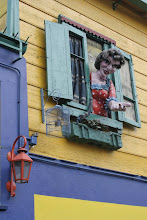
.jpg) This sweetheart waited patiently for some action on Sarmiento in Almagro.
This sweetheart waited patiently for some action on Sarmiento in Almagro.Her comparative advantage being legs, legs, legs and the best price in the neighborhood: "Soy la mas barata del Abasto".
.jpg) Next door "Hotel para caballeros", hotel for men..
Next door "Hotel para caballeros", hotel for men..
Thursday, November 22, 2007
"Sin triki triki no hay bang bang" - The cumbia latex
 *Campaign picture unauthorized reproduced from the magazine 7 Dias. Photographer unknown.
Sin triki triki no hay bang bang, the cumbia aids campaign towards the working class youth
http://www.trikitrikibangbang.com.ar/
Vamos con la cumbia triki triki
vamos con la cumbia
que la sabe poner
vamos con la cumbia triki triki
vamos con la cumbia
que tenes que aprender.
Yo tengo una piba, quee le gusta
el bang bang
pero algo le pasa, quando asomo
el bong bong
quando asomo el bong bong
se me planta de una,
y me frena el envión.
Metételo, tatuátelo
si hay triki triki
hay bang bang.
Si no pará, si no pirá,
si no hay triki
tomátela.
A todas las pibas, les encanta el
bang bang
les encanta el bang bang
y como a los pibes nos titila el
bong bong
la pelamos de una,
pero con capuchón.
Metételo, tatuátelo,
si hay triki triki
hay bang bang.
Si no pará, si no pirá, si no hay
triki triki, tomátela.
The campaign "Triki triki" is a stunt financed by The Global Fund Against Aids, TB and Malaria, a Geneva-based organization. This year the cumbia song Sin triki triki no hay bang bang, together with a powerful videoclip and billboards all over the more humbler parts of Buenos Aires, is part of an international action to support Argentinas great worry of the strong growth of HIV/AIDS among young people aged 14 to 24, particularly in the marginal neigbourhoods and villas. The campaign "Triki triki" wants to give a loud and clear and forcible message to the youth in a language and through aesthetics they understand and with which they identify, and at the same time embrace the rest of the population.

Desember 1st, the World's Aids-day was celebrated several places in the city. El Obelisco downtown was clad in the largest latex available (about 223 feet long/high..), I chose the concert with Babasonicos in Parque Patricio.
The memory of Villa Crespo
.jpg) Since Buenos Aires' strong growth in the XVIII century, barrios identified and named by their parishes appeared. During the XIX centrury and the beginning of the XX century, economic growth and emerging metropolization in Buenos Aires, the barrios grew rapidly. Several followed the railway enabling the poor to work in the city while living economically outside or in the periphery.
Since Buenos Aires' strong growth in the XVIII century, barrios identified and named by their parishes appeared. During the XIX centrury and the beginning of the XX century, economic growth and emerging metropolization in Buenos Aires, the barrios grew rapidly. Several followed the railway enabling the poor to work in the city while living economically outside or in the periphery.The barrios generated communities with their own clubs, cafes, schools and soccer teams. Like in every big city, this created powerful barrio identity, but in Buenos Aires this was stronger. The barrios of Buenos Aires are really small villages grown together and is carefully defined within this and that street and this and that corner. Between them are rivalry and imperialism.
The barrios has their own football teams, Atalanta belonging to Villa Crespo, Boca to Boca, River Los millionarios in the affluent northern neighborhoods of Nuñez and so on. A friend told me that his father took him to a Racing-match when he was three. From then on, supporting another team than Racing, would be treason. You are born to a club, you don´t choose one. Serious stuff.
Lately the real estate market have changed the borders between the barrios. Trendy San Telmo eats less fancy Montserrat. Uptown Belgrano comsumes parts of Nuñez. Hot Palermo consumes Colegiales. Rich Devoto have eaten Villa Real. In this context Palermo is the most interesting and disturbing case as the first imperialist barrio. The success of Colegiales becoming Palermo Hollywood has generated Palermo Soho and now real estate managers want to expand Palermo to the west, branding the central barrio Villa Crespo as Palermo Queens. Fact is, if Buenos Aires has a Soho, it ought to be the southern and less fancy barrio Barracas.
With the tango, the coffee and the soccer in the historic billiard bar San Bernardo on the edge of what the real estate agents wants to baptize Queens, those who have lived in Villa Crespo their whole life and gone to the same cafe for coffee every day do not like this palermization.
"We do not want the barrio to turn commercial and risk losing its identity. We want it to keep its soccer team Atalanta and its traditional places, like San Bernardo. A movie theatre would be nice and so would a shopping mall. Weekends on the corner of Scalabrini Ortíz and Corrientes we used to meet and hang out before taking off for the hottest boliche at the time."
The neigbourhood wants to preserve their tangible and intangible heritage. The tangible being the architecture, the streets, the aesthetics of the neighbourhood. The intangible being the memory, the culture and the local costums. In Villa Crespo that means a crucible mix of people and race, being the neighbourhood of imigrants and the tango. This is not some local idea, but governmental norm, working to keep the neighbourhoods history and thinking of ways the young people will appreciate the local touch and culture and make it their own.
.jpg)
This one speaks for itself.
.jpg) These three fellas shared Vasco Viejo and bread - Barrabravas de River, barrabravas being the porteño version of hooligans..
These three fellas shared Vasco Viejo and bread - Barrabravas de River, barrabravas being the porteño version of hooligans....he-he, a few years since they fought their counterparts in Boca, though.. now the brothers Alan and William Schlenker want to be in command, but Adrián Rousseau is still the big (mafia?) boss while the Schlenkers are waiting for trial in jail.
.jpg)
Juggling in the streets at red light.
.jpg)
Where they receive "all metal" in Villa Crespo.
.jpg)
Some parts of the city are more attractive on the real estate market that others, and so the porteños now see some barrios claming parts of another.
.jpg) Another defining Villa Crespo corner.
Another defining Villa Crespo corner..jpg)
Line 84 in Caballito..jpg) ....
.....jpg) Lunchtime Acevedo/Castillo. Churipan y media/media, sausage in bread with half and half red wine and soda.
Lunchtime Acevedo/Castillo. Churipan y media/media, sausage in bread with half and half red wine and soda.
Uruguayan blues
.jpg) Lovely small items and antiques at the Plaza Matíz in Montevideo.
Lovely small items and antiques at the Plaza Matíz in Montevideo..jpg) Ceramic tiles, tales of past grandeour.
Ceramic tiles, tales of past grandeour..jpg) Object by the Uruguayan painter José Gurvich.
Object by the Uruguayan painter José Gurvich.More famous is Joaquín Torres García who painted the Latin American continent upside down.
The Uruguayan journalist and writer Eduardo Galeano wrote Las venas Abiertas de Latino America (The Open veins of Latin America), the best book on the continent I ever read.
.jpg) South Atlantic waters.. Porteños regard Uruguay as a dull province of Argentina and the capital as a sad and melancholic city, but Montevideo has miles and miles of lovely beaches, which Buenos Aires hasn´t.
South Atlantic waters.. Porteños regard Uruguay as a dull province of Argentina and the capital as a sad and melancholic city, but Montevideo has miles and miles of lovely beaches, which Buenos Aires hasn´t. Beauty across Rio de la Plata.
.jpg) La libertad en el arte implica aventura.
La libertad en el arte implica aventura.La aventura implica responsibilidad.
Libertad sin responsabilidad es peligro de desorientación.
Jose Gurvich
.jpg) Timeout at the beach.
Timeout at the beach..jpg) I like the large beers, but this one is not the worlds best..
I like the large beers, but this one is not the worlds best...jpg) The car park of Montevideo is old. American 50s style Fords and Cadillacs and Volkswagen gone out of production.
The car park of Montevideo is old. American 50s style Fords and Cadillacs and Volkswagen gone out of production..jpg) Mercado del Puerto with the English clock.
Mercado del Puerto with the English clock..jpg) Meats in Mercado del Puerto.
Meats in Mercado del Puerto..jpg) Mate and thermos. Everywhere and at any time I spot mate-sipping argentinians and uruguayans.
Mate and thermos. Everywhere and at any time I spot mate-sipping argentinians and uruguayans..jpg) A ladies pistol or an old Mausser, anyone? Plaza Matríz, Old Town.
A ladies pistol or an old Mausser, anyone? Plaza Matríz, Old Town..jpg) Candombe music and drums, Brazilian influence.
Candombe music and drums, Brazilian influence..jpg) Fountain of locks. Legend says that if you write your name and the name of your lover on a padlock and hang it on the fountain, you will allways be together and you will allways return together to the fountain.
Fountain of locks. Legend says that if you write your name and the name of your lover on a padlock and hang it on the fountain, you will allways be together and you will allways return together to the fountain.
Montevideo wasn´t that nice...jpg) Fresh goose in the Feria de Tristan Narvaja.
Fresh goose in the Feria de Tristan Narvaja..jpg) Uruguay's flag. Buenos Aires in the horizon.
Uruguay's flag. Buenos Aires in the horizon..jpg) Cartonero, paper collector at work. Working horses still at use.
Cartonero, paper collector at work. Working horses still at use..jpg) Plaza Matríz, Old Town. Sunset.
Plaza Matríz, Old Town. Sunset..jpg) Herbs. Cure everything and make you slim too.. mix your own blend for the perfect mate.
Herbs. Cure everything and make you slim too.. mix your own blend for the perfect mate.
Los ojos al servicio del alma:
ver, sentir y comprender,
con el alma a través de los sentidos.
José Gurvich
This sweet little fella got his hand on 100 of my Uruguayan pesos. In return I got a very musky perfume and a tape with tangotunes copied from the radio: http://www.youtube.com/watch?v=iZVKMjjBiHY
Thursday, November 15, 2007
Life is a bitch and then you die...
After eight o´clock at night you leave your daily trash in a plastic bag in the street to be collected by the trash van cruising the streets at night.  When I noticed the night shift workers (cartoneros) coming along with their trolleys to sort my paper from glass from plastic from ordinary food waste from the rest by hand, and before the vans get a chance to collect my garbage, I realized the porteños had a system for sorting waste. I thought with horror of all the crap I put in the waste bin, and I stopped throwing my newspapers in the same bag as the orange peel and dental floss and...
Coming to think of it, a goverment run system for sorting waste would probably leave hundreds of people without income as they sell their paper and plastic and metal and glass by the pound.
And coming to think of something else: Where are all the rats? With so much garbage in the streets, there must be millions of thick, well fed rats. But I havn´t seen one. Nor a cockroach...
 When I noticed the night shift workers (cartoneros) coming along with their trolleys to sort my paper from glass from plastic from ordinary food waste from the rest by hand, and before the vans get a chance to collect my garbage, I realized the porteños had a system for sorting waste. I thought with horror of all the crap I put in the waste bin, and I stopped throwing my newspapers in the same bag as the orange peel and dental floss and...
Coming to think of it, a goverment run system for sorting waste would probably leave hundreds of people without income as they sell their paper and plastic and metal and glass by the pound.
And coming to think of something else: Where are all the rats? With so much garbage in the streets, there must be millions of thick, well fed rats. But I havn´t seen one. Nor a cockroach...
Carlos Fuentes in Malba Art Senter
The great Mexican writer Carlos Fuentes visited Buenos Aires at Malba (Musuo de Arte Latinoamericana de Buenos Aires) Wednesday 14th November. This is as close as I got, in the foyer, the auditorium was packed.
Afterwards they treated specially invited guests with wines and Mexican snacks. Living in hope, I hung around the restaurant to see if they would notice me slipping by, but the lady with the namelist kept giving me spiky looks.
Appearantly I was not among the worthy ones. Cool guy, though, 79 years old with of strong presens and great humor.
A true trancient experience, and I was there. When the dialouge with Silvia Hopenhayn was over, it was gone.
 He spoke of his fascination for the city where the collective coincide with the individual and he spoke of the problem of arts, music and litterature which only reproduce themselves (like fashion) and don´t really develop.
And like other great writers he admitted that writing is 10 % talent and inspiration. The remaining 90 % is work. Either you write or you don´t.
A donde voy
Por donde voy
A donde vuelvo
Carlos Fuentes
 Carlos Fuentes visited Buenos Aires at Malba (Musuo de Arte Latinoamericana de Buenos Aires) Wednesday 14th November. This is as close as I got, in the foyer, the auditorium was packed.
Afterwards they treated specially invited guests with wines and Mexican snacks. Living in hope, I hung around the restaurant to see if they would notice me slipping by, but the lady with the namelist kept giving me spiky looks.
Appearantly I was not among the worthy ones. Cool guy, though, 79 years old with of strong presens and great humor.
A true trancient experience, and I was there. When the dialouge with Silvia Hopenhayn was over, it was gone.
 He spoke of his fascination for the city where the collective coincide with the individual and he spoke of the problem of arts, music and litterature which only reproduce themselves (like fashion) and don´t really develop.
And like other great writers he admitted that writing is 10 % talent and inspiration. The remaining 90 % is work. Either you write or you don´t.
A donde voy
Por donde voy
A donde vuelvo
Carlos Fuentes
Tuesday, November 13, 2007
1ra Expo de Arte Villero
 Numerous artists participate in this first exhibition which shows the reality where the most marginalized sectors of the capitals population struggle every day. Villa 20 and 21, Barrio Piedrabuenba, Villa Zavaleta and Soldata, Villa 31 and 31b and Barracas is represented. Paintings, wall installations, photography, sculptures, Cumbia music and film.
 The exhibition has a clear message to the world: "No al Paco", "No a la Base", or "No to crack", "No to freebase". The poor mans drug. Cocaine manufacturings leftovers. Crap. Shit. Overflowing the poor neighbourhoods of every Latin American city. Paco, crack or base, freebase being the venom which destroys families and homes in these humble parts of the city. A great part of the dwellers in the villas has to front this every day, simply because here is where paco is traded. And abused. This picture was painted explicitly to be photographed and published by the public to broadcast the message.
.jpg) La Virgen next to a wall of clips from the paper: football, murder, poverty, drug abuse...documents of harsh living..
La Virgen next to a wall of clips from the paper: football, murder, poverty, drug abuse...documents of harsh living...jpg) Creativity in the poorest villas or barrios in Buenos Aires is expressed through a will to transform struggle and ugliness to beauty.
Creativity in the poorest villas or barrios in Buenos Aires is expressed through a will to transform struggle and ugliness to beauty..jpg) Peron, Evita, football heroes and the Cumbia stars Gilda and Rodrigo. All of them have some way or the other become (sub)cultural saints after their death.
Peron, Evita, football heroes and the Cumbia stars Gilda and Rodrigo. All of them have some way or the other become (sub)cultural saints after their death.Gilda and Rodrigo, both of whom died young in tragic car accidents, are now worshipped like angels or popular saints. Their fan clubs meet at their graves, eat, drink and sing. At the same time they are Catholics, and their worship builds on Catholisism.
This is a stigmatized practice and a pronounced lower class fenomenon. Those who involve themselves are poor and from the working class. At the same time the local music genre Cumbia is in itself stimatized and considered lower class, while the middle class listen to European and American music. Here you have the class perspective on the one hand and faith contra rationalism on the other. The word "fan" is also stigmatized, and ethymologically dericed from "fanatic", says Hanna Skartveit, social anthropologist who studied the phenomeneon. The worship is about identity and pride among the working class. And it is about death and how you relate to it. Poor people handle death and burial on their own, while the rich make bureaus take care of this, considered cold and impersonal by the poor.
The fan clubs meet at the graves, particularly at weekends, and they decorate the graves with balloons and flowers, offerings of cigarettes and they bring crusifixes and pictures of Virgin Mary. The idea is that the dead artists are some kind of guardian angels close to God who will bring him their prayers. As a fan you carry an image of your guardian angel everywhere and at any time, talk to him or her and ask for advice. If the weather is bad, this may be a sign that the saint is angry.
This is far from madness, although different. Relating to saints is common in Catholisism. And they talk not only to Gilda or Rodrigo, but also to canonized saints such as Virgin Mary. Many are very concious that this is distinct from canonized Catholisism, but they feel they have a mission; to protect the name of the artist and to portect the family and its honour.
.jpg) In Villa 21 a woman had made this Virgen sculpture and donated it to the exhibition.
In Villa 21 a woman had made this Virgen sculpture and donated it to the exhibition..jpg) Trains, trains and more trains. Estación de Contitución, or perhaps Retiro. Busy and chaotic.
Trains, trains and more trains. Estación de Contitución, or perhaps Retiro. Busy and chaotic.The desire to live a decent life is as strong among the marginalized part of the population as among the rest of us. Art represents a way to break through and create beauty from horror.
King Juan Carlos: "¿Por que no te callas?" a Hugo Chaves
Diplomacy is difficult, even for kings. South American summit in Santiago de Chile took an abrupt turn last Saturday when Spains King Juan Carlos had enough of Hugo Chávez endlessly asking why former Spanish prime minister José María Aznár the previous week on a visit to Venezuela had bothered him with critical questions about the constitutional reform which will give Chávez more power than ever and most likely ten more years (or more?) as president in Venezuela.
The Spanish prime minister José Luis Rodríguez Zapatero, propably a republican himself, awkwardly had to defend his adversary and political opponent Aznár. The king had enough and simply told Chávez to shut up: "¿Por que no te callas?" So much for diplomacy.
King Juan Carlos was present in the summint on the sole purpose of negotiating the tense situation the Finish celluloid company Botnia had created between Argentina and Uruguay. Operating in Uruguay and polluting (stinking) in Argentina, the economic and environmental interestest are incompatable. The Argentinian president Nestór Kirshner begged the Spanish king to negotiate the conflict between the neighbouring countries more than a year ago. And he agreed to do so. Funny thing for a king to do. And the negotiation drowned in the "(in)famous five words". The whole incident has triggered humorous repercussions, paroding theatre and ringtones (!) both in Venezuela and Spain. My personal favorite is a Viva España-version: http://www.youtube.com/watch?v=d9X8DYOA5DE
Last week the border between Gualeguaychú in Argentina and Fray Bentos in Uruguay (where Botnia is situated) was closed on the Uruguayan side. Thousands of demonstrators marched the bridge across Río Uruguay and swam the river in boats to protest the foul smell from the celluloid plant. In Buenos Aires demonstrators cooked huge amounts of coliflower in front of the Uruguayan embassy to simulate the stench. Anyone who has known mossalukta or sildalukta will sympatize. I hope the border is open tomorrow when I go on a weekend trip to Colonia and Montevideo...
Anyway, a couple of days after he was told to shut up, Chávez claimed he hadn´t noticed the kings outburst, otherwise he would have given him a harsh reply. What the fuck is a king these days, anyway. After 300 years of imperialized colonization it is time for the people to speak back. Says Chávez. In a sense he is right. But as the greatest superego in the Western hemisphere at the moment, he has lost his sense of proportion. Even Chávez' comrade Fidel Castro made public that he thought someone must be on the verge of putting a bullet through his head, Chávez is now on a dead end, en una callejon sin salida. Recently he was acclaimed the most sexy man in Venezuela (by his own TV channel)... Wonder how many votes he posted himself. On the other hand, power always was sexy.
Now Chávez is expecting an apology from Spain, and has decleared a revision of all Spanish
interests in Venzuela. Propably throwing out the ones who are not in sole Venezuelan interest.
 Now, play the 7 differences:
Compare the pictures from the Latin American Presidential Summit in Chile an find the differences (answers at the bottom)
1. Zapatero brakes Chavéz for criticizing Aznar. Kirschner applaudes Chávez for criticizing Carlos Menem.
2. Zapatero and Kirschner detest former presidents Aznar and Menem, but the former never publicly criticize Aznar outside Spain.
3. Outside Spain, Aznar is careful not to criticize Zapatero. Menem made an official, international statement against Kirschner.
4. Spain have king. Argentina, queen.
5. King Juan Carlos told Chávez to shut up. Queen Cristina told him not to miss her assumption.
6. Bachelet intended to reconcile Juan Carlos with Chávez. Kirchner wants to reconcile Chavéz with Bush.
7. Spain has hereditary morarchy. Argentina, too..
The Spanish prime minister José Luis Rodríguez Zapatero, propably a republican himself, awkwardly had to defend his adversary and political opponent Aznár. The king had enough and simply told Chávez to shut up: "¿Por que no te callas?" So much for diplomacy.
King Juan Carlos was present in the summint on the sole purpose of negotiating the tense situation the Finish celluloid company Botnia had created between Argentina and Uruguay. Operating in Uruguay and polluting (stinking) in Argentina, the economic and environmental interestest are incompatable. The Argentinian president Nestór Kirshner begged the Spanish king to negotiate the conflict between the neighbouring countries more than a year ago. And he agreed to do so. Funny thing for a king to do. And the negotiation drowned in the "(in)famous five words". The whole incident has triggered humorous repercussions, paroding theatre and ringtones (!) both in Venezuela and Spain. My personal favorite is a Viva España-version: http://www.youtube.com/watch?v=d9X8DYOA5DE
Last week the border between Gualeguaychú in Argentina and Fray Bentos in Uruguay (where Botnia is situated) was closed on the Uruguayan side. Thousands of demonstrators marched the bridge across Río Uruguay and swam the river in boats to protest the foul smell from the celluloid plant. In Buenos Aires demonstrators cooked huge amounts of coliflower in front of the Uruguayan embassy to simulate the stench. Anyone who has known mossalukta or sildalukta will sympatize. I hope the border is open tomorrow when I go on a weekend trip to Colonia and Montevideo...
Anyway, a couple of days after he was told to shut up, Chávez claimed he hadn´t noticed the kings outburst, otherwise he would have given him a harsh reply. What the fuck is a king these days, anyway. After 300 years of imperialized colonization it is time for the people to speak back. Says Chávez. In a sense he is right. But as the greatest superego in the Western hemisphere at the moment, he has lost his sense of proportion. Even Chávez' comrade Fidel Castro made public that he thought someone must be on the verge of putting a bullet through his head, Chávez is now on a dead end, en una callejon sin salida. Recently he was acclaimed the most sexy man in Venezuela (by his own TV channel)... Wonder how many votes he posted himself. On the other hand, power always was sexy.
Now Chávez is expecting an apology from Spain, and has decleared a revision of all Spanish
interests in Venzuela. Propably throwing out the ones who are not in sole Venezuelan interest.
Now, play the 7 differences:Compare the pictures from the Latin American Presidential Summit in Chile an find the differences (answers at the bottom)
1. Zapatero brakes Chavéz for criticizing Aznar. Kirschner applaudes Chávez for criticizing Carlos Menem.
2. Zapatero and Kirschner detest former presidents Aznar and Menem, but the former never publicly criticize Aznar outside Spain.
3. Outside Spain, Aznar is careful not to criticize Zapatero. Menem made an official, international statement against Kirschner.
4. Spain have king. Argentina, queen.
5. King Juan Carlos told Chávez to shut up. Queen Cristina told him not to miss her assumption.
6. Bachelet intended to reconcile Juan Carlos with Chávez. Kirchner wants to reconcile Chavéz with Bush.
7. Spain has hereditary morarchy. Argentina, too..
Tuesday, November 6, 2007
Tigre and the Delta
 Castrol gas station. Floating vehicles only.
 Beauty of the Delta. No cars and hopefully no crocodiles. I saw noone swim...
 Queen Elisabeth smiling far up the Paraná Delta. I have never seen a picture of her smiling before.
 The local bus.
 A mansion like this, with the fashionable address Muelle (pier) 294, can be yours for ten to fifty thousand dollars.
 This is propably more in the ten thousand range.
 Local flora.
 The pier in Tigre, where all the boats leave from.
 Local supermarket I.
 Local supermarket II. When you need groceries you simply leave a grocerybag on your pier with a list of what you need. The boat stops and exchange goods for money.
 I could live here...at least part of the year.
Subscribe to:
Comments (Atom)
.jpg)