Wednesday, October 31, 2007

City of bodies, looking and onlookers


The city is like a window where everything is transparent and in exhibition. Public space is exposition and exhibition space - in the double sense - to make oneself visible and put oneself to risk.
The public space is, by definition, the kingdom of diversity. In this crossroad of differences are born both forms of acceptance and resistence based on the way you observe and watch and whether or not to trust the others. A great part of the important things we´ve learned doesn´t come from home, school or the TV. It comes from the street.
A public space is a space accessible to everyone. Restrictions, predudices, exclusions create exceptions, amputating the character of public space. Therefore the quality of democracy is reflected in the accessability to public space. This is the thesis of Manuel Delgado, spanish anthropologist at the University of Barcelona. Buenos Aires made him optimistic.


Difference is necessary because difference means information and information is comunication. We wouldn´t have neither information nor comunication without differences. The city works because we are able to be indifferent to one another. What makes co-existense possible in public space is not respect for difference, rather the recognition of the right to be indifferent. The others do not bother about me and I do not bother about them. My presence in public space does not require any explanation.
Aristoteles taught that the city was made from multiple voices, while Richard Sennet says that the modern city is the space where the foreign and strange meet. Are todays cities a place for diversity? By definition the cities are heterogenous, Delgado says. Not because they want to, nor for reasons of ethics or esthetics, simply because the city needs diversity to survive, not to mention prosper.

The golden dream of a street without conflicts, where an illusionary middle class strolls happily only occurs in the magazines of urbanism. For reasons of sexuality, religion or appearance some have to hide. Going out in the streets represents a risk.

Magic happens when different worlds touch and mingle. El subte, where a million people pass every day is a place where this can happen, where religion meets sexuality meets class meets illness.
These contrasting meetings, exotic, apparently extravagant with a frequency linked to ritual and magic manifest themselves in any slits in urban life. This way you can encounter much more chamanism than in the jungle.
The city of bodies, lookers and onlookers is felt in el subte, bodies touch, glances meet and attention is fixed. The world of el subte is full of experiences like this. But our looks are stigmatizing. Women are prey to these looks. For women public space is different than for men. A single women in the street is an anomaly. She ought to be waiting for somebody. Womens conquest of the streets is through shopping. As a shopper she owns the streets and the public spaces.

Tuesday, October 30, 2007

Language of the streets: Lunfardo y vesre (or was it verse?)..

So you´ve ditched the fannypack and opted for an assymetrical rolinga haircut, but you still don´t pass for porteño. Why not? Because even if you´ve managed to learn Spanish, alongside younger Porteños, you most likely speak it like a 70-year-old nun. Unless you´ve mastered the art of flavoring your Spanish with a dash of Lunfardo. Lunfardo is the argot of Spanish which emerged from the lower classes in and around Buenos Aires during the late 19th and early 20th century. Originally brought to Argentina by European immigrants and gauchos from La Pampa, Lunfardo was born from a shady history of lawlessness and economic struggle. It is said to link back to a kind of "criminal underworld" and, in fact, is widely believed to have developed in jails as a vernacular spoken only among prisoners. The word lunfardo itself derives from the word "lombardo", which once signified "outlaw" in several Italian dialects.

Lunfado plays a prominent role in lyrics of tango, magnifying the mystery of this musical genre. It is not a complete language but rather a set of words and expressions which are sprinkled throughout most tango lyrics, employed more heavily by certain musicians such as Celedonio Flores.

Lunfardo expressions have worked their way into everyday language as well, becomming integral to Spanish spoken in both Argentina and Uruguay. In addition to a colorful vocabulary, Lunfardo is characterized by a use of wordplay known as vesre. With vesre, syllables are reversed, so tango becoms gotán and café con leche becomes feca con chele.

In recent decades, a number of modismos or common slang expressions have emerged and evolved in youth porteño speech. While some consider this modern slang to qualify as Lunfardo, others contend that these modern linguistic distortions lack the crucial historical roots. Most prominent is the crass boludo, about as common as a bum in the subte, and a staple in young porteño lingo. The term, a derivation of bolo (testicle) has a range of uses. When coupled with Che, a term of affection, it can be used endearingly to greet a friend: "Che boluda, qué tal de nuevo?" It may also be an expletive, "Ay boludo! me duele mi cabeza por tomar tanto!" or an insult, "Saliste con mi novia, boludo?" In this case, pelotudo might also be used - a derivation of a pelota (testicle), meaning "idiot" or "prick". Porteños have a colorful array of interpretations for boludo, ranging from "someone with big, hairy balls" to "someone who has sex with goats". In any case, as an outsider, use of the term will likely earn you approving looks, as if you have just uttered a secret, conspiratorial code.

Some other examples of modern slang include:
Gomas (lit. tyres) - womens breasts
Trucho - counterfeit, fake
Zafar - to barely get by
Maza (lit. mace or sledgehammer) - superb
Curtir (lit. to tan) - to be involved in..

From jailcells to tango salons, Lunfardo merges an esoteric past with a hip present, marking porteño Spanish with a singular flare. Lunfardo may cause the prudish or the conventional to cringe, but for many porteños, this distinctive dialect, with its deep historical and cultural roots, heralds the revolutionary power of language. This is freedom of speech at its finest.

"Che boludo, mira las gomas de esa boluda! Eso es la maza...Podrías manyarlas."
"Polotudo! Esa es mi esposa!"


Examples of classic lunfardo expressions:
Manyar - to know/to eat (from the Italian mangiare - to eat)
Morfar - to eat (from French argot morfer - to eat)
Laburar - to work (from Italian argot lavoro - work)
Chochamu - young man (vesre for muchacho)
Garpar - to pay with money (vesre for pagar - to pay)
Gomías - friends (vesre for amigos)
Fiaca - laziness (from Italian fiacco - weak)
Engrupir - to fool somone (unknown origin, but used in modern portuguese slang)
Junar - to look to/ to know (from Caló junar - to hear)
Feca - coffee (vesre café)
Zapi - pizza (vesre pizza)
Zapan - belly (vesre panza)
Gotan - tango (vesre tango)
Broli - book (vesre libro)
Ñoba - bathroom (vesre baño)

In Contitución, on Calle Estados Unidos 1397, is the real thing located:
Academia de Lunfardo de Buenos Aires

Cristina Kirchner becomes president


Cristina Kirchner won the elections by far. December 10th she will take over the office from her husband. With twice as many votes as her main rival Eliza Carrió, she gained 43,9% on a national basis, beaten only in the capital by Elisa Carrió, in Cordoba by Roberto Lavagne and in San Luis by Alberto José Rodrígues Saá. But the winner is still the non-voter. In the capital less than 22 % of the citizens voted! On a national basis less than 50% did.

There are reports of chaos and long lines in the voting localities. Lists were missing and people had to wait. And there were a shortage of staff attending the voters. The Argentinians still remember the Junta and know that democracy was hard-won. Still they don´t seem to care to post their vote. One could hope that womens liberation is taking a huge step ahead with the first elected women president in the Argentinas history. And still many women dont bother to co-decide this. Wasn´t it for the question of abortion..

During her campaign she met both Angela Merkel and Nicolas Sarkozy in Europe and Lula de Silva i Brazil and Hugo Chavez to build international alliances. And though she is not a good friend with Chavez as her husband, she will continue their cooperation. Her aim is to get a grip on inflation and stop poverty and hunger among her people.

The International Money Fund will not sanction a refinanciation of Argentinas 6 billion dollar foreigh debt before the new government presents a plan for stabilizing economy and particularly inflation, even though G7 and The Paris Club are eager to do so. Tango for three..

Sunday, October 28, 2007

Chimichurri

A hideous busride with no available seats on line 168 crossing through the city to la Boca and the Constitución station. Chaos! El Subte to San Telmo, from there we backtrack into Constitución and San Juan, to a 7th floor shady terrace, alive with expats and argentinians, smelling of delicious parrilla composed of friends, meats (asados, matambre, costillas, salchichas, chorizos), salads, bread and lots of wine, music on the stereo and lazy saturday afternoon streetsounds from down below.

When the Chimichurro comes on the table, we are all set. This staple sauce of parsley, oregano, cummin, thyme, garlic, chili, olive oil and red peppers that accompanies all grilled meats is more readily available than ketchup. And of course, everybody has their own recipe. They say that the preparation of Chimichurri, which mixes Spanish and Italian methods, is a general reflection of Argentine society as a whole. Shake up a bottle and you will see the spices at the bottom rise up symbolically, like tiny little citizens in an edible allegorical snow globe. The compositon derived from Genovese pesto, while another legend says that the Irishman Jimmy McCurry was the first to prepare the sauce. And since he was such a drunk, he presented himself as "Chimmeee Churreee" to people.

Eating and drinking for hours, talking of anything from a Strauss concert in Coliseo later in the evening (since the beautiful operahouse Teatro Colon is renovating), the kingdom of Patagonia (som nut frenchman crowned himself King of Patagonia and the Araucanians) in the beginning of the 19th century, the beautiful beaches on the Atlantic coast outside Nicochea in Argentina or Cabo Polonia and Puente del Diablo in Uruguay, the disappeared and everything else... The sun sinks behind the rooftops and is replaced by stars and a decending moon, we still talk and eat and drink. Someone leaves for work, others have to take their baby home. Daft punk on the stereo now, we dance.

Salud para los dos minutos de belleza del dia que hagan la vida vale vivir.

Chimichurri

parsley
(coriander)
1 cup olive oil
1/2 cup vinagre
4-10 garlic cloves
1/4 onion, finely chopped
2 tablespoon oregano
2 tablespoon paprika
fresh chili
2 lemons (juice)
(1 tomato finley chopped)
(1 paprika finely chopped)
1/2 tablespoon cummin
2 tablespoon salt
1 tablespoon thyme
red pepper
(laurel)

Mix everything except oil and vinagre in a bowl, toss well. Let rest while your rearrange your kitchen for better feng shui. Add vinagre (and water). Mix well and let rest. You can play som music, smoke a joint and take a dance. Add oil, liquids must cover the rest of the ingredients. Let rest in the refigerator or indulge!

Sunday, October 21, 2007

Thoughts on the presidential election 28. october


Sunday Argentina will elect their new president. Cristina Kirchner is a clear favorite and has spent by far the largest sum of money on her campaign compared to he opponents. But nothing is given.

Educated a lawer and active on the Peronist side in the political picture since the 70s before the dictatorship, she has a heavy political corpus and twice been elected senator, in Santa Cruz and now in the capital. Admirer of Evita (!) and of Hillary Clinton as female politicians, she is clearly the most glamourous of the candidates, better looking than twenty years ago.

The poor, the young and people living in rural areas support her, but among porteños she is not very popular. They want Elisa Carrió (left) as their next president and find Cristina too arrogant and snobbish. For a candidate that did´t speak to the press until two days before elections, one can understand that. And where have the election campaign debates been?

For a country that rich in resources, meat to feed 300 million people and a climate which could make anything grow, it is a marvel that people still starve. And with the exception of the last four years with Cristinas husband, Nestor Kirschner as the president, no government has managed the national economy. The peso is weak, worth a third of a dollar. Argicultural exports are high and national industry is booming. People have jobs to go to again. Having said that, a taxidriver claimed that not even the Nobel prize winners in economy understood the dynamics of Argentinas economy. But the composition of their economic structure must be a happy mixture of straight corporate finance, national investments and money in the matresses. Coins for instance, are scarce. People seem to save and hide them. No kiosco accepts anything but small change. Even the national bank doesn´t understand where all the coins are hidden and claims that there are sufficient in sirculation. But there aren´t. And the informal economy is formidable. Taxidrivers hear a lot and talk a lot.

It might look like Cristina could be able to do a great deal. At least she claims to know and understand what is missing and how to get it. And her status as first lady and perhaps, her husband's prime advisor, during the economic recovery also helps. Her credibility in Europe was manifested when she, as a senator, visited Angela Merkel in Berlin a month ago in September. As the largest foreign loangiver to Argentina through the Paris Club, Germany is ready to renegotiate their terms if she becomes president. Argentinas national foreign debt to Europe was frozen when the economic crisis was a fact in 2001. One taxidriver said, when I asked him what he thought would be the outcome of the elections: Cristina, cierto, no hay otra!

Broke...

Being broke is also a state. Money ran out and new haven´t arrived. A fortune teller once told me 'to clear my pockets of money to make room for new ones'. And so I have.
The porteño way to deal with that is to spend hours occupying the best table at the plaza, sharing a coffee and all the thick sunday papers. Sundays exist for the sole purpose of papers and of indulging in long, heavy lunches with huge red beefs accompanied by lots of wine at an outside table in a nice parrilla watching everybody else as they pass by on the street (two- and fourlegged).
Meanwhile I do the free stuff. Gym (already paid the month), taking photos (digital - no film expenses), knitting (have gorgeous alpaca wool, regrettably not vicuna), read (the former tenant left some books in English), eat the fridge empty (already bought the food, besides the thing needs a defrost so that the door might close again), suntan on the balcony (although scary from the fourteenth floor)... Life could be so light it wouldn´t be bearable.
Paythings include tango- ... and artlessons... good thing I don´t need to go to soccermatches.

Saturday, October 20, 2007

Dog City

Bs As is definitely my favorite city. Why? There are as many dogs as there are porteños. Well, almost. And they treat their dogs well. My favorites are the german shepards and the golden retrievers, and they are everywhere. Not so nice to slip in their left-behinds, though.. In my next life I want to be a professional dogwalker.


Wednesday, October 17, 2007

Like an elephant in a porcelain store


I found this drawing in Clarin today and wonder if somebody spied on me in Tangocool last week.

Days run away like wild horses over the hill

A poem by Charles Bukowski.

Things doesn't always work the way they should. Back from workout the shower was cold, water spilled all over the floor, Internet was down when I needed my e-mail account, the fridge is (still) full of ice and will not close properly and the lightbulb went out...

Charming, like Spain twenty years ago.

I forgive everything when the repairman-magician comes and fix the hot water. He gets his tip and I get a kiss on the cheek.

And I forgive everything when I read in Clarin that the average household has 21,50 pesos a day to buy necessary groceries.

I just go and do some more workout.

Time is slow. Los porteños are informal and always late. Everybody is late because everybody depends on the public transport (el subte, the buses or the taxis) which is either on strike, generally late or plainly stuck in traffic. And everybody knows that everybody else has the same excuse for being late.

Mornings are fresh and slightly foggy until the sun breaks through around ten. Trees are flowering, most of the species particular to the continent: lapachos (pink in september), bella sombra (ombú), gum tree, palos borrachos (white in february) and jacaranda (about to flower lila) and a whole lot of others I haven't figured yet.

The smell is thick with parrillo (argentine grill) every evening after eight.

Espias... luego existes

A gay couple shows off their intimate space on Gorriti 5182 without doing anything in particular. Realityshow by Nadia Gómez. 24 hours from 8 pm tonight. Funny... and a little sick.

Las Pulgas in Palermo Hollywood was a turnoff... a warehouse full of old crap.

Nordic canapees at Olsen in Gorriti, though, were a treat.

Monday, October 15, 2007

The tastes of Bs As


Pan...


y licores.


Jamon de las Pampas. From Feria de Mataderos' sunday market.


Ají envasado


Los chinos sell vegetables and fruits. Recently there was a tomato boicott due to the escalating price.


The really tasty Volcan de chocolate at the french restuarant Petanque in Defensa.

Tango

Carlos Gardell - father of Argentinian tango. He died young in a flight crash i the thirties.


New tangoshoes? The tangoshop Flabella in Suipacha 263 might help you. Also i Suipacha (380) is the milonga Confitería Ideal.


Tango orchestra in San Telmo a sunday afternoon in september.


For those who prefer to listen.


Outdoor milonga in Defensa (San Telmo). If you need a job, this is a fun option.


Dance is a perpetual vanishing point (Marcia Siegal). Outdoor tango-couple in cartón de piedra.

The BsAs boom is not for everybody

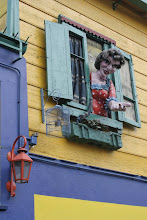
Colors of La Boca


Paper collector.


Not good..


..but clearly worse

Feria de Mataderos

These days gauchos also reads books.


Gaucho showing off his horseback skills.


Sweet little puppy resting in the saddle..


The sunday parrilla is nearly finished. The smell is delicios.


Feria de Mataderos. Mataderos is named after the barrio where they brought the cattle in from the pampas to the slaugterhouses. For the same reason, the barrio is also named Nueva Chicago.


Saturday, October 13, 2007

Boca Jr.-San Lorenzo Apertura Oct. 3rd 2007

Bs As' grand children: Carlos Gardell, Evita and Maradona.


Peanuts?


Boca colors.


Fifteen hundred police officers guarded the match and looked after the fans form both teams so that they behaved well. These two fellas charge energy with a huge parrilla. I wonder if they paid for their lunch..



Later they dressed in helmets and shields.


Boca is ahead with one goal.