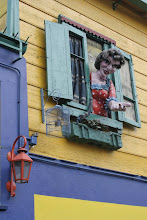
Hang out. Moved a week ago, two streets up and 10 floors down. Better feeling closer to the ground. But views cannot compete...
Mornings with newspapers and coffee.
Draw, work out and write.
Afternoons in the shade accompanied by the Polish writer Witold Gombrowicz´diaries from Buenos Aires in the 50s and 60s, preferably with a glass.
Family spend time with football and friends. Time on my own.
Tuesdays Reina comes and cleans the establishment. Groceries brought to the door. With a telephone and cash you don´t need to go out at all.
Need to exit the country to renew visa. Daytrip to Colonia in Uruguay.
Temperatures normalizing. Divine evenings, long nights and late mornings. More than a month left of school break and summer holiday.
Porteño summer is hot, dampy and slow.
Concert season coming up, Interpool March 8th and Dylan the fifteenth highlights..so far. Meanwhile outdoor (and free!) indie-rock in Parque Lezama Fridays and Saturdays through February.
In the middle of life, Buenos Aires, summer.
Expat-life is strange, lonely and suggestive.
Wednesday, January 30, 2008

Tuesday, January 22, 2008
Barbie
The other day some workers called ¡Barbie! as I passed them on Humberto 1. I gave them my sweetest smile, a swing on the hips and a gracias.
¡Hermosa! another chico wispered as he passed on Acevedo.
Everyday flirts of the streets make my afternoons, I chuckle along to el subte and my downtown classes, well aware of being beyond Barbie-(st)age...there are limits to what XXL gym can do to saggy old flesh...
¡Hermosa! another chico wispered as he passed on Acevedo.
Everyday flirts of the streets make my afternoons, I chuckle along to el subte and my downtown classes, well aware of being beyond Barbie-(st)age...there are limits to what XXL gym can do to saggy old flesh...
The world wants to be deceived
World-wide economic crack, and Cristina tries to tranquil her people by announcing that their economy is immune (sic.) to what is happening. I had to reread Clarin's national headline this morning.
Do they really beleive their economic growth since 2003 is their sole acheivement? Or is there a slight possibility that their growth is connected with general world-wide growth?
Worst case: Willfull deseption. Even worse case: Ignorance and naivité (not an option: Martín Lousteau is far to smart).
Do they really beleive their economic growth since 2003 is their sole acheivement? Or is there a slight possibility that their growth is connected with general world-wide growth?
Worst case: Willfull deseption. Even worse case: Ignorance and naivité (not an option: Martín Lousteau is far to smart).
Saturday, January 12, 2008
La Semana Tragica 1919
In 1919, demands from the Vasena workshops regarding working conditions derived one of the most serious social conflicts and fiercest repressions in Argentinian and Porteño history.
Few expected the strike which started in December 1918 in the metallurgic workshops of Pedro Vasena e Hijos (on Cochabamba and La Rioja, today Plaza Martín Fierro in the southern Barrio of San Cristobal) of workers who intended to improve their working and salary conditions, leading to a public social conflict which passed on in history as la Semana Trágica, the Tragic Week.
The First World War had triggered a crisis in the metallurgic industry, and Vasena decided that the workers should pay the cost of the crisis, reducing their wages and at the same time increasing labour stock with women and children at slavery conditions. The 2500 workers declared strike 2nd of December 1918. They didn´t ask for much: Eight hour working day, healthy working conditions and a fair wage.
Vasena showed themseves intransigent fronted with the blue collar worker´s "insolence". The workers therefore decided to take over the factory and put together a picket to guard the establishment in defence of their rights. Vasena enjoyed close relations with Yrigoyen´s government and obtained policemen and firemen to discipline and punish the "rudeness".
It all started January 7th when a group of strikers forming a picket tried to prevent the arrival of raw materials to the factory. The drivers passing the strikers, ignoring their true mission, started to fire arms at the workers. Police forces were called, and the saldo spoke for itself: four dead. Three of them where shot in their houses and one perished from a cosacos, the riding police', sabel chop. More than 30 people were wounded. According to La Prensa more than 2000 projectiles were fired from some 110 police- and firemen. Only three members of the repressive forces were lightly wounded.
The official story does not recognize the names of the dead men. They were:
Juan Fiorini, Argentinian, 18 years, single, worker at Bozzalla Hnos., dead from a bullet in the chest while drinking mate (herb tea) in his house.
Toribio Barrios, Spanish, 42 years, married, cartonero (collector of garbage), dead from several sabel blows in the head in front of Avenida Alcorta 3189.
Santiago Gómez Metrolles, Argentinian, 32 years, single, cartonero (collector of garbage), dead from a bullet while in a bar in Av. Alcorta 3521.
Miguel Britos, married, dead from bullet wounds (1).
None of these men died in actions of combat, none of them showed agressiveness towards the repressive forces.
January 8th the workers convoked an urgent syndicalist or guild reunion and the FORA V anarquists proclaimed general strike from January 9th, day of the burial of the victims. FORA V declared sorrow and invited their affiliates to participate in the burial. About 5 pm January 9th an endless and moving column of workers arrived at Chacarita cemetery. While the leader Luis Bernard spoke, members of the police and the armed forces started to shoot into the crowd. It was an ambush. According to the newspapers there were 12 dead and nearly 200 wounded. The working press spoke of 100 dead and more than 400 wounded. Both versions agreed that there were no casualties among neither the police nor the military. Nothing like it had ever happened before.
But the mobilized people were not intimidated by this and continued down the street claiming justice and asking their leaders to carry on the general strike, which effectively took place.
From these early days of January 1919 La Liga Patriótica Argentina was born, an armed band of youths from "the best Argentinian families" who shouted !Viva la Patria¡, and armed to their teeth entered workers localities, public libraries, jewish localities, shops and synagogues devastating everything along their way.
The agitation continued and while the massacre of Chacarita took place a group of workers surrounded the Vasena factory and were about to set fire to it when the new leader of the police force and the future Alvear's vice precident, don Elpidio González, came to negotiate with the workers and plead them to calm down. The funeral procession were attacked and the police chief's car were set to fire from the crowd.
González had to return in taxi from his mission, but he sent a group of 100 fire- and policemen who shot without halting at the provocing crowd, and according to the police this resulted in 24 dead and 60 wounded.
In the middle of the general upheavel of January 9th, general Luis F. Dellapiane, commander of Campo de Mayo, decided to come to Buenos Aires and present himself at the Casa Rosada. From Yirigoyen he demanded a hard hand on the strikers. Finally, January 11th the government came to a radical agreement with FORA IX based on the liberation of the prisoners, who added up to more than 2 000; salary rise from 20 to 40 %, nine hour working day and reemployment of all the dismissed strikers.
Shortly after the authorities of the syndicalist FORA and the socialist party Partido Socialista solved the return to work. On their part, the anarchist FORA V opposed the forced gauge and decided to "continue the movement as a form of protest against the crimes of the state" (2).
By Thursday January 16th Buenos Aires were almost back to normal. The troops returned to their quarters and the railway-workers back to work. Only the 20th of January the workers at Vasena, after deciding that all their demands where completed and that none of their colleagues were fired nor sanctioned, went back to work.
The wealthiest sectors of society showed themself very grateful to the repressive forces and wanted to reward them with money. The businesses who benefited from the "social discipline", the beneficency ladies and other entities for the "public good" initiated purses "for the defence of order". Nobody took notice of the families of the more than 700 dead and 4 000 wounded.
Only several months later, the charity ladies and the hierarchy of the Catholic church launched a purse to raise funds to give alms to the families most in need. And they did it in their own interest:
Part of the text from "The Great National Purse" goes like this:
"Dime: ¿qué menos podrías hacer si te vieras acosado por una manada de fieras hambrientas, que echarles pedazos de carne para aplacar el furor y taparles la boca? Los bárbaros ya están a las puertas de Roma".
"Tell me: What is the least you could do if you were chased by a flock of fiercly hungered people, if not to throw them some slabs of meat to appease the fury and shot their mouths? The barbarics are now at the gates of Rome".
1. "La Nación", 8 de enero de 1919.
2. Diego Abad de Santillán, "La FORA", Buenos Aires, Ediciones Nervio. 1933.
Source: Felipe Pigna, historican. fpigna@clarin.com
Contemporary implications/connotations:
Gremiales today; The syndicates remain strong
The 1994 bomb on the Jewish synagogue killing more than 100 people - although this was possibly a "Middle-Eastern" issue in the light of recent arrests in Europe.
Few expected the strike which started in December 1918 in the metallurgic workshops of Pedro Vasena e Hijos (on Cochabamba and La Rioja, today Plaza Martín Fierro in the southern Barrio of San Cristobal) of workers who intended to improve their working and salary conditions, leading to a public social conflict which passed on in history as la Semana Trágica, the Tragic Week.
The First World War had triggered a crisis in the metallurgic industry, and Vasena decided that the workers should pay the cost of the crisis, reducing their wages and at the same time increasing labour stock with women and children at slavery conditions. The 2500 workers declared strike 2nd of December 1918. They didn´t ask for much: Eight hour working day, healthy working conditions and a fair wage.
Vasena showed themseves intransigent fronted with the blue collar worker´s "insolence". The workers therefore decided to take over the factory and put together a picket to guard the establishment in defence of their rights. Vasena enjoyed close relations with Yrigoyen´s government and obtained policemen and firemen to discipline and punish the "rudeness".
It all started January 7th when a group of strikers forming a picket tried to prevent the arrival of raw materials to the factory. The drivers passing the strikers, ignoring their true mission, started to fire arms at the workers. Police forces were called, and the saldo spoke for itself: four dead. Three of them where shot in their houses and one perished from a cosacos, the riding police', sabel chop. More than 30 people were wounded. According to La Prensa more than 2000 projectiles were fired from some 110 police- and firemen. Only three members of the repressive forces were lightly wounded.
The official story does not recognize the names of the dead men. They were:
Juan Fiorini, Argentinian, 18 years, single, worker at Bozzalla Hnos., dead from a bullet in the chest while drinking mate (herb tea) in his house.
Toribio Barrios, Spanish, 42 years, married, cartonero (collector of garbage), dead from several sabel blows in the head in front of Avenida Alcorta 3189.
Santiago Gómez Metrolles, Argentinian, 32 years, single, cartonero (collector of garbage), dead from a bullet while in a bar in Av. Alcorta 3521.
Miguel Britos, married, dead from bullet wounds (1).
None of these men died in actions of combat, none of them showed agressiveness towards the repressive forces.
January 8th the workers convoked an urgent syndicalist or guild reunion and the FORA V anarquists proclaimed general strike from January 9th, day of the burial of the victims. FORA V declared sorrow and invited their affiliates to participate in the burial. About 5 pm January 9th an endless and moving column of workers arrived at Chacarita cemetery. While the leader Luis Bernard spoke, members of the police and the armed forces started to shoot into the crowd. It was an ambush. According to the newspapers there were 12 dead and nearly 200 wounded. The working press spoke of 100 dead and more than 400 wounded. Both versions agreed that there were no casualties among neither the police nor the military. Nothing like it had ever happened before.
But the mobilized people were not intimidated by this and continued down the street claiming justice and asking their leaders to carry on the general strike, which effectively took place.
From these early days of January 1919 La Liga Patriótica Argentina was born, an armed band of youths from "the best Argentinian families" who shouted !Viva la Patria¡, and armed to their teeth entered workers localities, public libraries, jewish localities, shops and synagogues devastating everything along their way.
The agitation continued and while the massacre of Chacarita took place a group of workers surrounded the Vasena factory and were about to set fire to it when the new leader of the police force and the future Alvear's vice precident, don Elpidio González, came to negotiate with the workers and plead them to calm down. The funeral procession were attacked and the police chief's car were set to fire from the crowd.
González had to return in taxi from his mission, but he sent a group of 100 fire- and policemen who shot without halting at the provocing crowd, and according to the police this resulted in 24 dead and 60 wounded.
In the middle of the general upheavel of January 9th, general Luis F. Dellapiane, commander of Campo de Mayo, decided to come to Buenos Aires and present himself at the Casa Rosada. From Yirigoyen he demanded a hard hand on the strikers. Finally, January 11th the government came to a radical agreement with FORA IX based on the liberation of the prisoners, who added up to more than 2 000; salary rise from 20 to 40 %, nine hour working day and reemployment of all the dismissed strikers.
Shortly after the authorities of the syndicalist FORA and the socialist party Partido Socialista solved the return to work. On their part, the anarchist FORA V opposed the forced gauge and decided to "continue the movement as a form of protest against the crimes of the state" (2).
By Thursday January 16th Buenos Aires were almost back to normal. The troops returned to their quarters and the railway-workers back to work. Only the 20th of January the workers at Vasena, after deciding that all their demands where completed and that none of their colleagues were fired nor sanctioned, went back to work.
The wealthiest sectors of society showed themself very grateful to the repressive forces and wanted to reward them with money. The businesses who benefited from the "social discipline", the beneficency ladies and other entities for the "public good" initiated purses "for the defence of order". Nobody took notice of the families of the more than 700 dead and 4 000 wounded.
Only several months later, the charity ladies and the hierarchy of the Catholic church launched a purse to raise funds to give alms to the families most in need. And they did it in their own interest:
Part of the text from "The Great National Purse" goes like this:
"Dime: ¿qué menos podrías hacer si te vieras acosado por una manada de fieras hambrientas, que echarles pedazos de carne para aplacar el furor y taparles la boca? Los bárbaros ya están a las puertas de Roma".
"Tell me: What is the least you could do if you were chased by a flock of fiercly hungered people, if not to throw them some slabs of meat to appease the fury and shot their mouths? The barbarics are now at the gates of Rome".
1. "La Nación", 8 de enero de 1919.
2. Diego Abad de Santillán, "La FORA", Buenos Aires, Ediciones Nervio. 1933.
Source: Felipe Pigna, historican. fpigna@clarin.com
Contemporary implications/connotations:
Gremiales today; The syndicates remain strong
The 1994 bomb on the Jewish synagogue killing more than 100 people - although this was possibly a "Middle-Eastern" issue in the light of recent arrests in Europe.
Were Borges a Precursor to Internet?
The same day Bill Gates announced his retreat from Microsoft to dedicate himself to Gates' Foundation, Noam Cohan publiched a story in the New York Times and Clarin on Jorge Luis Borges as a possible percursor to the Internet.
Perla Sassón-Henry's book Borges 2.0: from Text to Virtual Worlds explores the relationship between decentralized Internet as YouTube, blogs and Wikipedia with Borges' texts from the early 1940s. And for that matter, the Spanish-linguistic Wikilengua launched two days ago. To Sassón-Henry, Borges is "someone from the old world with a futuristic vision", as her work Cy-borges on the same theme shows.
Borges' works Funes, el memorioso (1942), La Biblioteca de Babel (1941) and Tlön, Uqbar, Urbis Tertius (1940) were published under the English title Labyrinths in the 1960s. His infinite libraries, total memory and man who never forget, virtual encyclopedias and worlds, information and portals that embrace the whole planet, created a canon for everyone who find themselves in the intersection of new technology and literature.
Perla Sassón-Henry's book Borges 2.0: from Text to Virtual Worlds explores the relationship between decentralized Internet as YouTube, blogs and Wikipedia with Borges' texts from the early 1940s. And for that matter, the Spanish-linguistic Wikilengua launched two days ago. To Sassón-Henry, Borges is "someone from the old world with a futuristic vision", as her work Cy-borges on the same theme shows.
Borges' works Funes, el memorioso (1942), La Biblioteca de Babel (1941) and Tlön, Uqbar, Urbis Tertius (1940) were published under the English title Labyrinths in the 1960s. His infinite libraries, total memory and man who never forget, virtual encyclopedias and worlds, information and portals that embrace the whole planet, created a canon for everyone who find themselves in the intersection of new technology and literature.


La Jungla
 Chavéz: I am happy to have helped liberate the hostages...those poor people who were held in such an uninviting place; stickily hot, with no electricity and sometimes no water.
Kirchner: What? Where they kept in Buenos Aires?
Subscribe to:
Comments (Atom)